Abstract
Introduction:
Parents often use digital devices to regulate their children's negative emotions, e.g., to stop tantrums. However, this could hinder child development of self-regulatory skills. The objective of the study was to observe bidirectional longitudinal associations between parents' reliance on digital devices to regulate their child's emotions and self-regulatory tendencies (anger/frustration management, effortful control, impulsivity).
Methods:
Parents (N = 265) filled out the Child Behavior Questionnaire—Short Form and the Media Assessment Questionnaire twice: the initial assessment (T1) took place in 2020 (mean child age = 3.5 years old), and follow-up (T2) occurred a year later in 2021 (mean child age = 4.5 years old).
Results:
Higher occurrence of parental digital emotion regulation (PDER) in T1 predicts higher anger and lower effortful control in T2, but not impulsivity. Higher anger in T1, but not impulsivity and effortful control, predicts higher PDER in T2.
Discussion:
Our results suggest that parents of children with greater temperament-based anger use digital devices to regulate the child's emotions (e.g., anger). However, this strategy hinders development of self-regulatory skills, leading to poorer effortful control and anger management in the child.
1 Introduction
Digital device use among young children is markedly increasing. Children are introduced to screens at earlier and earlier developmental stages (1). Screen-based activities occupy the largest part of children's free time, compared to outdoor play or other screen-free activities (2). Pre-pandemic studies report that preschoolers spend about 1.5–2.5 h in front of a screen daily (3, 4), and this amount has increased by one hour during the pandemic (5). The proportion of families that possess mobile devices has increased from 52% in 2011 to 98% in 2020 and almost half of 2- to 4-years-olds have their own mobile device (6). About 26% of children aged 0–4 from the United States spend more than 4 h in front of a screen daily, meaning a two-fold increase compared to 13% before the pandemic (7). Despite these tendencies the effects of screen time on child emotional and cognitive development are still debated and largely unknown (8). The widespread usage of electronic media and digital devices (TV, videogames, PC, smartphones, tablets, etc.) may influence even adults' cognition, emotions, and mental health (9, 10). However, young children's brain and cognitive processes are still plastic, making them even more potentially vulnerable to strong and long-lasting influences of experiences (11–13).
Early childhood is a critical time for learning basic self-regulation skills (14). Self-regulation is conceptualized as the organization or modulation of affective, mental, and behavioral responses, including control over emotional experiences and expressions (i.e., emotion regulation), cognitive processes (i.e., executive function), and approach or withdrawal behaviors (i.e., effortful control) (15). Executive function and effortful control are related and, according to some researchers, overlapping constructs (16, 17). Effortful control has been defined as children's ability to inhibit a dominant response in favor of a subdominant one, or an automatic response in favor of a deliberate one (18, 19). It involves the management of attention or behavior. Effortful control is temperamentally based, but also develops with considerable input from the environment (19) especially through children's early social relationships with their parents (20, 21).
Emotion regulation involves implicit or explicit attempts to modify the natural trajectory of one or more parameters of emotion (22), including physiological arousal, expression, intensity or duration. It is related to temperamental emotional reactivity [high reactivity hinders its effectiveness (23);], and to coping [i.e., the ability to cope with the stressful situation (24, 25)]. Emotion regulation emerges in rudimentary forms in infancy (26), and gradually progresses from being a highly external process to an internal one over time (25). Certain early childhood experiences, e.g., appropriate family interactions are necessary for this developmental process (27).
In the past decades, digital devices have become increasingly prevalent in people's lives and became objects with which emotions, cognition, and behavior can be regulated. Therefore, devices and screen-based activities have become external tools of self-regulation. For example, digital activities (e.g., videogaming, watching videos, instant messaging) often serve an emotion-regulating purpose in adults [“digital emotion regulation”; (28); for a review: (29)]. They help in coping with or recovery from negative emotions and stress by providing a sense of mastery and control (29, 30), an immersive or “flow” experience (31–33), and by providing a distraction from real-life problems or escape from reality into the virtual world (34). Digital activities offer instant rewards (35, 36) which can modulate one's mood and emotions. Digital activities can also help in arousal-regulation for individuals with lower arousal by offering stimulation through e.g., fast-paced, intensive, simultaneous stimuli (8, 37) or arousing (e.g., violent) contents, which activate the dopamine and the reward pathways (8).
Parents often give digital devices to their child to “safely” engage them (“baby-sitter” function), and to regulate their emotions or behavior (38–40). Kabali et al. (41) found that 65% of parents use mobile devices to keep their child calm in public places. Television is also commonly used as a calming tool for children (42, 43). We refer to this phenomenon as parental digital emotion regulation (PDER), designating parental behaviors such as giving the child a digital device to regulate their negative emotions or calm them down.
Providing children with digital devices as “digital pacifiers” (41) may reduce child emotional expressions in the short term and may help parents allocate resources to necessary tasks and provide them with free time, especially during lockdown (44). However, this practice may also lead to missed opportunities to teach adaptive emotion regulation and coping strategies to the child (45). Although the distraction of attention away from stressful stimuli or negative emotions can be an effective short-term strategy to reduce emotional intensity in young children (46), suppressing emotions can have paradoxical, rebounding effects [e.g., (47)], and it may lead to maladaptive, avoidant coping strategies, increased negative emotionality or dysregulation in the future. Additionally, for children with immature self-regulatory skills, it may be harmful to become accustomed to external devices to regulate their emotions, as this could interfere with the development of internal regulatory mechanisms. Dependence on the device may lead to problematic media use and “screen time tantrums” (48), i.e., extreme emotions when media is removed (40). In addition, when digital devices are used for getting instant rewards (35, 36), it may hinder one's ability to delay gratification and control impulses (49, 50). This may lead to a positive feedback loop. As a consequence, an association is frequently found between media use and impulsivity (51–53) or poorer executive functions (54–57).
Empirical evidence suggests a negative association between digital media use and self-regulation. For example, more time spent watching TV was associated with higher ratings on negative emotionality, emotional reactivity, aggression, and attention problems, as well as lower levels of soothability in toddlers (58). Children who began using screen media devices earlier or who spent more time engaging with mobile devices displayed lower self-regulation (59). Longitudinal data mainly suggest bidirectional relationships. For example, screen time or digital media use at a younger age was negatively associated with later child self-regulation or related processes, such as executive function and effortful control (37, 55, 57, 60–62). However, findings also support the reverse association: emotion dysregulation and poor self-regulation was found to contribute to greater and more problematic media use later (37, 42, 63, 64). However, whether bidirectional associations exist between the use of PDER and child self-regulation remains unknown.
The few studies investigating PDER suggest its potential role in child self-regulatory skills development. Coyne et al. (40) found that temperamental dysregulation risk factors, specifically negative affectivity and surgency (65, 66), were related to problematic media use and screen time tantrums through PDER. This suggests that difficult temperament (entailing low self-regulation skills) leads to PDER, which, in turn, leads to problematic media use. In line with this, children with social-emotional difficulties, poor self-regulation and a difficult temperament have a higher chance of being given digital technology as a calming tool or as a baby-sitter (39, 42, 43, 67, 68) and perhaps as a result, they use more media later (37, 62, 64, 69).
However, as far as we know, only one longitudinal study (69) investigated the bidirectional associations between PDER and child self-regulation. This study found an interaction effect: PDER in an earlier time point (T1) was positively related to increases in children's negative emotionality in a later time point (T2), but only for children with initially low negative emotionality. Further longitudinal studies are needed as the above-mentioned results are not in line with the frequently found bidirectional association between media use and self-regulation. Therefore, the objective of the study was to observe bidirectional longitudinal associations between PDER and child self-regulatory tendencies (anger/frustration management, effortful control, impulsivity). Since self-regulatory skills are still immature in the preschool age, PDER can have a great impact on them. Therefore, we aimed to investigate this age group. We also accounted for the confounding effects of parenting stress, child screen time, and family sociodemographics.
This is a confirmatory study with clear hypotheses: we expect that poorer child self-regulatory tendencies (i.e., higher level of anger/frustration management problems, impulsivity and lower level of effortful control) (at T1) lead to higher PDER (at T2), and that higher PDER (at T1) leads to poorer child self-regulatory tendencies (higher anger/frustration management problems and impulsivity, and lower level of effortful control) (at T2).
2 Materials and method
2.1 Procedure and participants
This study is part of a larger, two-year longitudinal study on digital media use by Canadian families with preschool children aged 2–5 years during the COVID-19 pandemic. Participating families were recruited using eye-catching posters and flyers in preschools and pre-kindergarten classes, sign-up sheets and presentations given at preschool and pre-kindergarten registration nights, a Facebook page, and newspaper and radio advertisements broadcast across Nova Scotia (Canada). To measure bidirectional associations between parental digital emotion regulation and child self-regulation tendencies, we measured these variables at two time points.
The first assessment took place between March and August of 2020 (N = 316 children), during a provincially declared state of emergency and lockdown. A follow-up with this sample was conducted a year later, between April and August of 2021 (N = 265; a flow diagram of the participants is presented in Figure 1). Demographics for the retested sample are presented in Table 1.
Figure 1
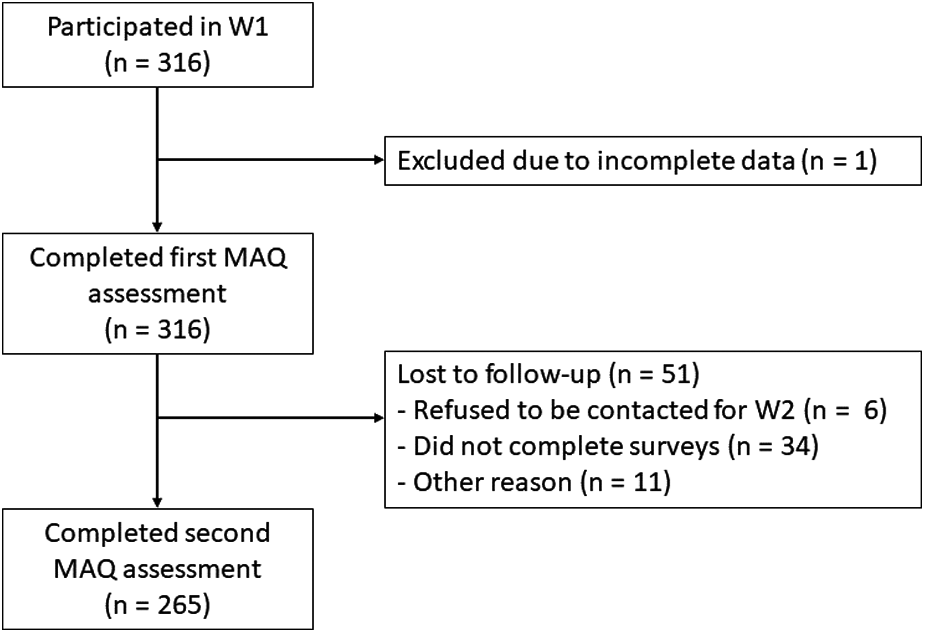
Flow diagram showing the number of participants contacted, lost for specific reasons and retained.
Table 1
| Variable | Measure | N (%) | M ± SD (Min, Max) |
|---|---|---|---|
| Child age T1 | In years | N (%) missing = 1 (0.4) | 3.46 ± 0.84 (2, 5.42) |
| Child age T2 | In years | N (%) missing = 0 | 4.33 ± 0.86 (2.75, 6.33) |
| Child sex | (2 values) | N (%) boys = 138 (52.1) N (%) girls = 126 (47.5) N (%) missing = 1 (0.4) | |
| Parent age T1 | In years | N (%) missing = 0 (0) | 35.24 ± 4.28 (23, 52) |
| Parent age T2 | In years | N (%) missing = 0 (0) | 36.24 ± 4.28 (24, 53) |
| Parent sex | (2 values) | N (%) males = 20 (7.5) N (%) females = 245 (92.5) N (%) missing = 0 (0) | |
| Parental education | (3 values) | N (%) college or secondary degree = 62 (23.4) | |
| N (%) bachelor's degree = 129 (48.7) | |||
| N (%) master or doctoral degree = 74 (27.9) N (%) missing = 0 (0) | |||
| Yearly income | (3 values) | N (%) $59,999 and less = 40 (15.1) | |
| N (%) 60,000–$99,999 = 72 (27.2) | |||
| N (%) $100,000 and more = 136 (51.3) N (%) missing = 17 (6.4) | |||
| Race | (7 values) | N (%) Aboriginal = 2 (0.8) N (%) Asian = 5 (1.9) N (%) Black = 2 (0.8) N (%) White = 242 (91.3) N% Don't know = 0 (0) N (%) Prefer not to answer = 1 (0.4) N (%) Other = 12 (4.5) N (%) missing = 1 (0.4) | |
| Country of birth | (2 values) | N (%) Canada (country) = 239 (90.2) N (%) Other = 25 (9.4) N (%) missing = 1 (0.4) | |
| Marital status | (6 values) | N (%) Married = 218 (82.3) N (%) Single/Never married = 11 (4.2) N (%) Live-in partner = 28 (10.6) N (%) Divorced = 2 (0.8) N (%) Widowed = 0 (0) N (%) Separated = 5 (1.) N (%) missing = 1 (0.4) | |
| Child screen time T1 | In hours/day | N (%) missing = 0 (0) | 3.45 ± 2.45 (0, 10.43) |
| Child screen time T2 | In hours/day | N (%) missing = 0 (0) | 3.26 ± 2.38 (0, 9.65) |
| Parenting stress T1 | (total score 0–5) | N (%) missing = 0 (0) | 1.85 ± 0.53 (1, 3.76) |
| Parenting stress T2 | (total score 0–5) | N (%) missing = 0 (0) | 1.14 ± 0.72 (0, 3.11) |
| CBQ anger T1 | (total score 0–7) | N (%) missing = 0 (0) | 4.25 ± 1.11 (1, 7) |
| CBQ anger T2 | (total score 0–7) | N (%) missing = 0 (0) | 4.26 ± 1.15 (1, 6.67) |
| CBQ impulsivity T1 | (total score 0–7) | N (%) missing = 0 (0) | 4.43 ± 0.93 (1.67, 7) |
| CBQ impulsivity T2 | (total score 0–7) | N (%) missing = 0 (0) | 4.19 ± 0.94 (1.33, 6.83) |
| CBQ effortful control T1 | (total score 0–7) | N (%) missing = 0 (0) | 4.71 ± 0.82 (2.58, 6.83) |
| CBQ effortful control T2 | (total score 0–7) | N (%) missing = 0 (0) | 4.88 ± 0.82 (2.75, 7) |
| Parental digital emotion regulation T1 | (after merging: 2 values) | N (%) never/rarely = 165 (62.3) N (%) regularly/frequently = 100 (37.7) N (%) missing = 0 (0) | |
| Parental digital emotion regulation T2 | (after merging: 2 values) | N (%) never/rarely = 179 (67.5) N (%) regularly/frequently = 86 (32.5) N (%) missing = 0 (0) |
Descriptive statistics of the final sample (N = 265).
At both time waves, parents completed the web-based Media Assessment Questionnaire (MAQ), which has been described in detail elsewhere (70). The MAQ assesses child and parent media use and includes questions on child age and sex, parent education, as well as reasons reported by parents to allow their child to use media. For the purpose of this study, we integrated items on child temperamental anger/frustration, impulsivity and effortful control using the Child Behavior Questionnaire—Short Form (71). We also integrated items on parenting stress using the Parenting Stress Index (72). These measures are described below. The use of data for this specific study received approval from the ethics board from the principal investigator's institution (IRB #2021-2927). Informed consent to participate was obtained from participating parents.
2.2 Measures
2.2.1 Parental digital emotion regulation (PDER)
Parents were asked to rate how much they agreed or disagreed with the statement “I let my child use media to calm them down when they are upset”. Responses were rated on a 7-point Likert scale ranging from Never (1) to Several times per day (7). Due to some of the response options having very small frequencies (e.g., “Several times per day”: N = 4), this variable was then recoded into a dichotomous variable (1 = Never/rarely, 2 = Regularly/frequently; see Table 1 for descriptives).
2.2.2 Child self-regulatory tendencies
The Child Behavior Questionnaire—Short form (71) assesses several distinct dimensions of temperament which are grouped into three main factors: negative affectivity, surgency/extraversion, and effortful control. The short form shows satisfactory internal consistency, criterion validity, longitudinal stability and inter-rater agreement (71, 73). Since we focus on temperament-based self-regulatory tendencies, we retained for this study (1) anger/frustration (“anger” hereinafter) which is a dimension belonging to the negative affectivity main factor, (2) impulsivity which is a dimension belonging to the surgency/extraversion main factor, and finally (3) the main factor of effortful control. Anger (e.g., “Child gets angry when told s/he has to go to bed”) and impulsivity (e.g., “Usually rushes into an activity without thinking about it”) were each based on the mean of 6 items. Higher scores in anger and impulsivity subscales indicate greater intensity and duration of the child's angry or frustrated response to environmental stimuli or greater speed of response initiation, respectively. The effortful control factor was based on mean scores obtained for the dimensions of attentional focusing (six items, e.g., “When drawing or coloring a book, shows strong concentration”) and inhibitory control (six items, e.g., “Can wait before entering into new activities if s/he is asked to”). Higher scores in the attentional focusing and the inhibitory control subscales indicate better child effortful control. Items are scored on a 7-point Likert scale ranging from 1 (extremely untrue of your child) to 7 (extremely true of your child). The Cronbach's alpha coefficients for anger, impulsivity, and effortful control in Wave 1 were α = 0.789; 0.629 and 0.792, respectively. In Wave 2, the corresponding coefficients were α = 0.814; 0.656 and 0.785, respectively (see Table 1 for descriptives).
2.2.3 Demographics, parenting stress and child screen time
When completing the MAQ (70), parents reported child age and sex (assigned at birth), parent age and sex, parent education, yearly income, race, country of birth, marital status, and parenting stress. Race, country of birth and marital status were not used in the analyses because there was little variance on these variables (see Table 1 for response options and number/percentage of participants answering them). Parenting stress was assessed using the Parenting Stress Index (72). This questionnaire includes a Parental distress (PD) subscale (12 items, i.e., “I find myself giving up more of my life to meet my child's needs than I ever expected”) and a Parent-child dysfunctional interaction (PCDI) subscale (12 items, i.e., “My child smiles at me much less than I expected”). Items were rated on a 5-point Likert scale as: 1 (strongly disagree); 2 (disagree); 3 (not sure); 4 (agree) or 5 (strongly agree) and were then averaged to create a total score ranging from 1 to 5, with an adequate internal consistency (Cronbach's alpha = 0.850). Higher scores indicate higher parenting stress (see Table 1 for descriptives).
In the MAQ, parents also reported their child screen time by reporting the average amount of time their child spent doing each of the following activities: (1) Watching TV or DVDs; (2) Using a computer; (3) Playing video games on a console; (4); Using an iPad, tablet, LeapPad, iTouch, or similar mobile device (excluding smartphones); or (5) Using a smartphone. For each activity, response options were: (1) Never; (2) Less than 30 min; (3) 30 min to 1 h; (4) 1–2 h; (5) 2–3 h; (6) 3–4 h; (7) 4–5 h; and (7) more than 5 h. Parents reported this separately for a typical weekday and a typical weekend day. Total amount of child screen time was calculated by summing the durations for each activity, using responses' mid-points with the exception of “Never” and “more than 5 h” where scores of 0 and 5 were used, respectively. To compute child average daily screen time, we computed a weighted average of screen time across the week as follows: [(weekday screen time X 5) + (weekend screen time X 2)]/7 (see Table 1 for descriptives).
2.3 Data analytic strategy
First, we compared whether retained (those who participated at T2) and unretained (those who had dropped out) participants were different in any aspects of demographics, parental digital emotion regulation (PDER), or child self-regulation scores (Mann–Whitney tests, t-tests and χ2 tests, using SPSS 28.0.0.0).
Of the final retained sample of 265, 17 participants had a missing value on income and one participant had a missing value for child anger, impulsivity, and effortful control at T2. We performed Little's test to determine if data were missing completely at random (MCAR). The test was not significant revealing that data could be assumed to be MCAR: χ2 = 24.476, DF = 26, p = 0.549.
We imputed missing values on income to the median (value of 3) and used FIML (maximum likelihood information) to account for missing outcome data.
To test bidirectional associations between PDER and self-regulation scales, we estimated cross-lagged panel models using Mplus version 8.10 (74). We controlled for sociodemographic variables such as child age and sex, parent age and sex, parent education, yearly income, child screen time and parenting stress (the model schema is presented on Figure 2).
Figure 2
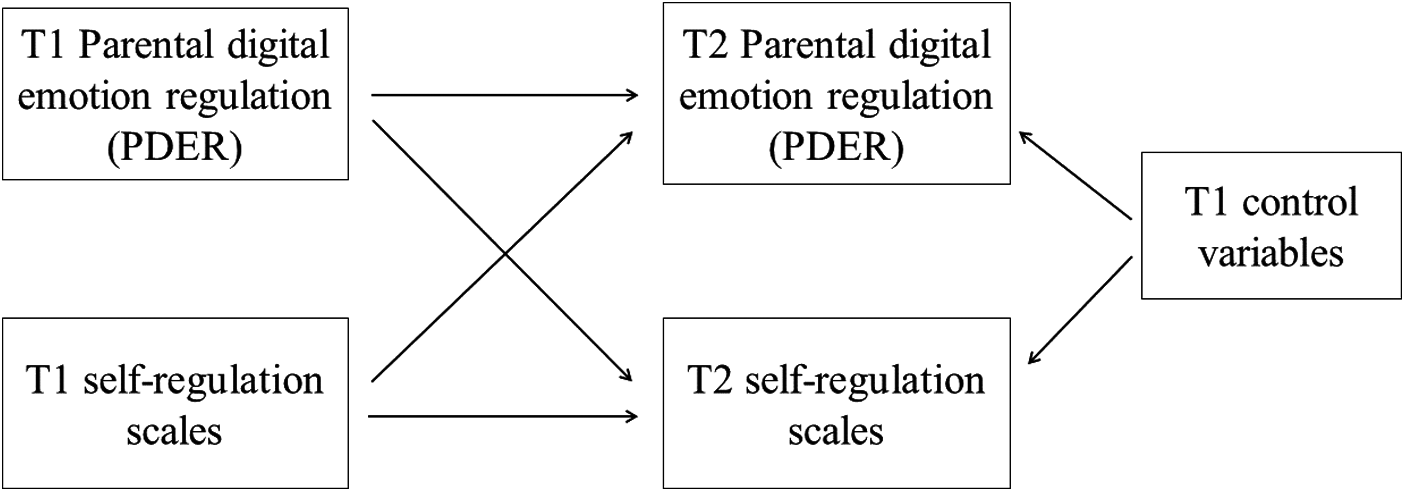
Summary of the cross-lagged panel analyses.
3 Results
3.1 Comparing retained and unretained participants
Unretained participants were significantly different from retained participants in parents' age (M ± SD = 33.32 ± 4.631 (unretained) vs. 35.226 ± 4.278 years (retained); t = 2.852; p = 0.005; Cohen's d = 0.436) and marginally in PDER (52% vs. 37.6% of regular/frequent PDER in unretained and retained sample, respectively; χ2 = 3.643; p = 0.056; this is discussed in the limitation section), but was not significantly different on any other demographic variables or child behavior variables (all p > 0.170).
3.2 Cross-lagged panel model: anger
Our final model is presented in Figure 3. Our cross-lagged panel model provided good fit [CFI = 1.000; TLI = 1.000; RMSEA = 0.000 (0.000; 0.138)] and accounted for 36.7% and 45.8% of the variance in PDER and Anger at T2, respectively. Analyses revealed considerable stability in PDER (b = 1.233; SE = 0.187; p < 0.001; β = 0.476) and Anger (b = 0.567; SE = 0.054; p < 0.001; β = 0.546) between T1 and T2. In terms of the cross-lagged associations, T1 PDER significantly contributed to higher Anger at T2 (b = 0.304; SE = 0.122; p = 0.013; β = 0.128), whereas T1 Anger only tendentiously contributed to higher PDER at T2 (b = 0.180; SE = 0.108; p = 0.094; β = 0.159). Parenting stress (b = 0.018; SE = 0.007; p = 0.008; β = 0.124) and child screen time (b = 0.063; SE = 0.024; p = 0.009; β = 0.133) at T1 were also significantly positively associated with Anger at T2 (Table 2).
Figure 3
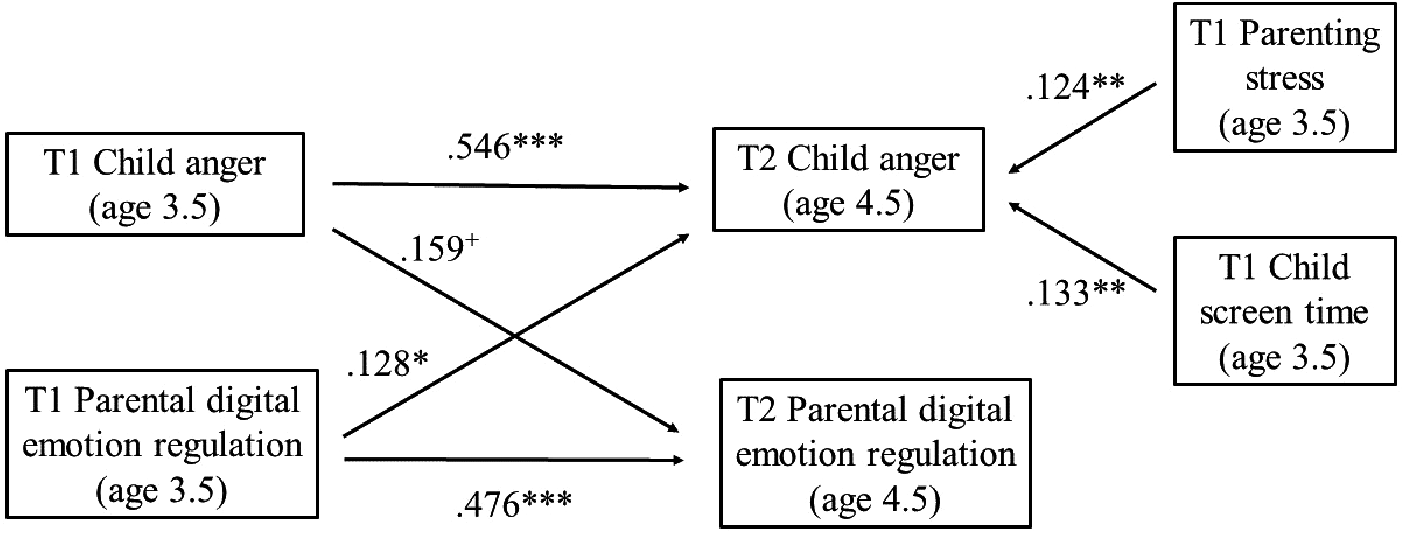
Longitudinal cross-lagged associations between parental digital emotion regulation and the anger/frustration dimension of the child behavior questionnaire.
Table 2
| Estimate (b) | se | p-value | Beta | |
|---|---|---|---|---|
| Child age → T2 PDER | −0.168 | 0.118 | 0.155 | −0.112 |
| Child sex → T2 PDER | −0.064 | 0.190 | 0.737 | −0.025 |
| T1 screen time → T2 PDER | 0.054 | 0.043 | 0.209 | 0.105 |
| Parent age → T2 PDER | −0.022 | 0.025 | 0.359 | −0.077 |
| Parent sex → T2 PDER | 0.018 | 0.382 | 0.962 | 0.004 |
| Parent education → T2 PDER | 0.127 | 0.146 | 0.384 | 0.073 |
| Yearly income → T2 PDER | −0.048 | 0.124 | 0.700 | −0.028 |
| T1 parenting stress → T2 PDER | −0.002 | 0.013 | 0.870 | −0.013 |
| T1 PDER → T2 PDER | 1.233 | 0.187 | 0.000 | 0.476 |
| T1 Anger → T2 PDER | 0.180 | 0.108 | 0.094 | 0.159 |
| Child age → T2 Anger | −0.021 | 0.072 | 0.768 | −0.015 |
| Child sex → T2 Anger | −0.066 | 0.113 | 0.558 | −0.029 |
| T1 screen time → T2 Anger | 0.063 | 0.024 | 0.009 | 0.133 |
| Parent age → T2 Anger | 0.020 | 0.014 | 0.153 | 0.073 |
| Parent sex → T2 Anger | −0.314 | 0.178 | 0.078 | −0.072 |
| Parent education → T2 Anger | 0.066 | 0.082 | 0.425 | 0.041 |
| Yearly income → T2 Anger | 0.036 | 0.081 | 0.658 | 0.023 |
| T1 parenting stress → T2 Anger | 0.018 | 0.007 | 0.008 | 0.124 |
| T1 anger → T2 Anger | 0.567 | 0.054 | 0.000 | 0.546 |
| T1 PDER → T2 Anger | 0.304 | 0.122 | 0.013 | 0.128 |
Results of the cross-lagged panel model measuring the bi-directional associations between PDER (parental digital emotion regulation) and the anger/frustration dimension of the child behavior questionnaire.
3.3 Cross-lagged panel model: impulsivity
Our model is presented in Figure 4. Our cross-lagged panel model provided good fit [CFI = 1.000; TLI = 1.000; RMSEA = 0.000 (0.000; 0.078)] and accounted for 34.7% and 47.8% of the variance in PDER and Impulsivity at T2, respectively. Analyses revealed considerable stability in Impulsivity (b = 0.670; SE = 0.051; p < 0.001; β = 0.659) between T1 and T2. In terms of the cross-lagged associations, neither T1 PDER was associated with T2 Impulsivity (b = −0.064; SE = 0.094; p = 0.496; β = −0.033), nor T1 Impulsivity with T2 PDER (b = 0.019; SE = 0.096; p = 0.845; β = 0.014). Child age was significantly negatively associated with Impulsivity at T2 (b = −0.126; SE = 0.057; p = 0.028; β = −0.112; Table 3).
Figure 4
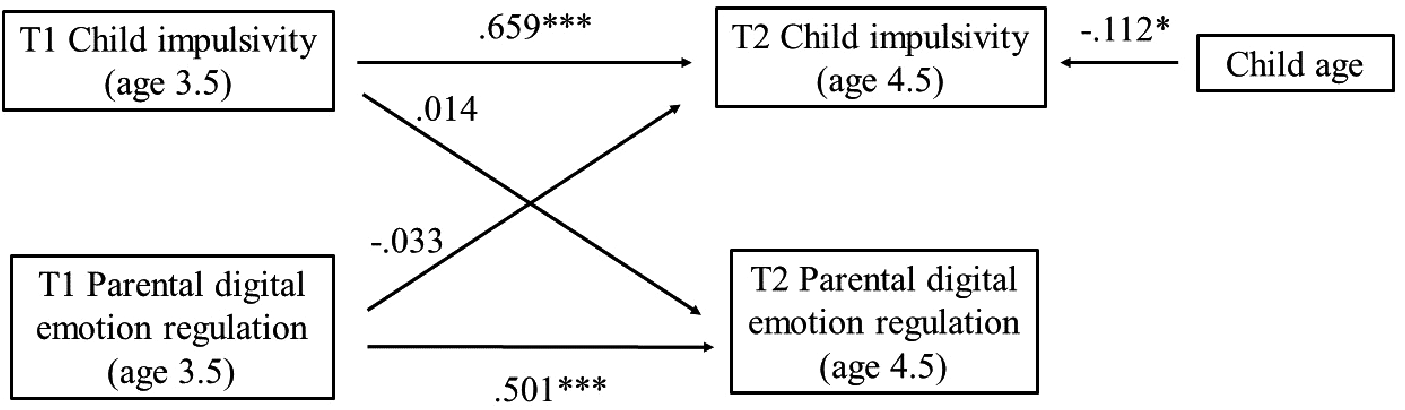
Longitudinal cross-lagged associations between parental digital emotion regulation and the impulsivity dimension of the child behavior questionnaire.
Table 3
| Estimate (b) | se | p-value | Beta | |
|---|---|---|---|---|
| Child age → T2 PDER | −0.167 | 0.118 | 0.158 | −0.114 |
| Child sex → T2 PDER | −0.059 | 0.189 | 0.755 | −0.024 |
| T1 Screen time → T2 PDER | 0.064 | 0.043 | 0.138 | 0.127 |
| Parent age → T2 PDER | −0.025 | 0.025 | 0.304 | −0.087 |
| Parent sex → T2 PDER | −0.007 | 0.395 | 0.986 | −0.001 |
| Parent education → T2 PDER | 0.117 | 0.145 | 0.422 | 0.068 |
| Yearly income → T2 PDER | −0.037 | 0.121 | 0.761 | −0.022 |
| T1 parenting stress → T2 PDER | 0.006 | 0.012 | 0.597 | 0.039 |
| T1 PDER → T2 PDER | 1.276 | 0.185 | 0.000 | 0.501 |
| T1 Impulsivity → T2 PDER | 0.019 | 0.096 | 0.845 | 0.014 |
| Child age → T2 Impulsivity | −0.126 | 0.057 | 0.028 | −0.112 |
| Child sex → T2 Impulsivity | −0.122 | 0.087 | 0.160 | −0.065 |
| T1 screen time → T2 Impulsivity | 0.022 | 0.021 | 0.297 | 0.057 |
| Parent age → T2 Impulsivity | −0.004 | 0.012 | 0.761 | −0.016 |
| Parent sex → T2 Impulsivity | 0.203 | 0.145 | 0.164 | 0.057 |
| Parent education → T2 Impulsivity | 0.103 | 0.064 | 0.106 | 0.079 |
| Yearly income → T2 Impulsivity | −0.083 | 0.066 | 0.207 | −0.065 |
| T1 parenting stress → T2 Impulsivity | −0.004 | 0.005 | 0.491 | −0.031 |
| T1 Impulsivity → T2 Impulsivity | 0.670 | 0.051 | 0.000 | 0.659 |
| T1 PDER → T2 Impulsivity | −0.064 | 0.094 | 0.496 | −0.033 |
Results of the cross-lagged panel model measuring the bi-directional associations between PDER (parental digital emotion regulation) and the impulsivity dimension of the child behavior questionnaire.
3.4 Cross-lagged panel model: effortful control
Our model is presented in Figure 5. Our cross-lagged panel model provided good fit [CFI = 1.000; TLI = 1.000; RMSEA = 0.000 (0.000; 0.000)] and accounted for 34.7% and 55.5% of the variance in PDER and Effortful control at T2, respectively. Analyses revealed considerable stability in Effortful control between T1 and T2 (b = 0.716; SE = 0.050; p < 0.001; β = 0.718). In terms of the cross-lagged associations, T1 PDER significantly contributed to lower Effortful control at T2 (b = −0.182; SE = 0.075; p = 0.016; β = −0.108), whereas T1 Effortful control did not contribute to higher PDER at T2 (b = −0.002; SE = 0.129; p = 0.986; β = −0.001). Parent age was also significantly negatively associated with Effortful control at T2 (b = −0.019; SE = 0.008; p = 0.022; β = −0.098; Table 4).
Figure 5
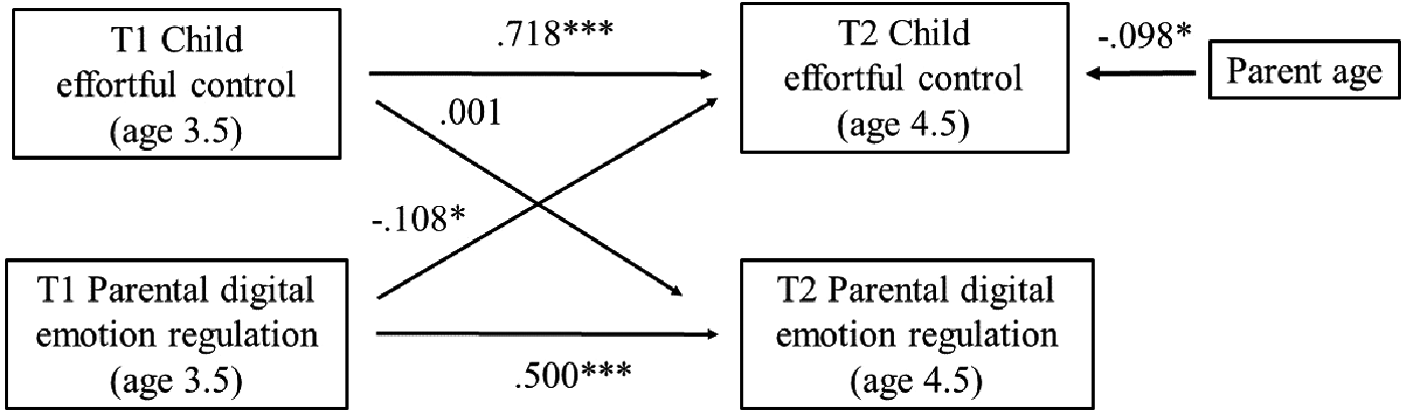
Longitudinal cross-lagged associations between parental digital emotion regulation and the effortful control main factor of the child behavior questionnaire.
Table 4
| Estimate (b) | se | p-value | Beta | |
|---|---|---|---|---|
| Child age → T2 PDER | −0.168 | 0.120 | 0.160 | −0.115 |
| Child sex → T2 PDER | −0.061 | 0.189 | 0.749 | −0.024 |
| T1 Screen time → T2 PDER | 0.066 | 0.042 | 0.118 | 0.130 |
| Parent age → T2 PDER | −0.025 | 0.025 | 0.303 | −0.088 |
| Parent sex → T2 PDER | −0.008 | 0.395 | 0.983 | −0.002 |
| Parent education → T2 PDER | 0.117 | 0.146 | 0.423 | 0.068 |
| Yearly income → T2 PDER | −0.039 | 0.120 | 0.749 | −0.023 |
| T1 parenting stress → T2 PDER | 0.006 | 0.012 | 0.618 | 0.038 |
| T1 PDER → T2 PDER | 1.275 | 0.186 | 0.000 | 0.500 |
| T1 effortful control → T2 PDER | −0.002 | 0.129 | 0.986 | −0.001 |
| Child age → T2 Effortful control | −0.066 | 0.048 | 0.164 | −0.068 |
| Child sex → T2 Effortful control | 0.091 | 0.071 | 0.202 | 0.055 |
| T1 screen time → T2 Effortful control | −0.015 | 0.016 | 0.349 | −0.044 |
| Parent age → T2 Effortful control | −0.019 | 0.008 | 0.022 | −0.098 |
| Parent sex → T2 Effortful control | −0.108 | 0.139 | 0.437 | −0.035 |
| Parent education → T2 Effortful control | 0.013 | 0.049 | 0.788 | 0.012 |
| Yearly income → T2 Effortful control | 0.039 | 0.048 | 0.418 | 0.035 |
| T1 parenting stress → T2 Effortful control | 0.005 | 0.006 | 0.383 | 0.046 |
| T1 effortful control → T2 Effortful control | 0.716 | 0.050 | 0.000 | 0.718 |
| T1 PDER → T2 Effortful control | −0.182 | 0.075 | 0.016 | −0.108 |
Results of the cross-lagged panel model measuring the bi-directional associations between PDER (parental digital emotion regulation) and the effortful control main factor of the child behavior questionnaire.
4 Discussion
We investigated the relationships between parental digital emotion regulation and self-regulation in children. Our study revealed complex, bidirectional longitudinal associations between the investigated variables. The results suggest that parental digital emotion regulation may contribute to the bidirectional association between media use and self-regulation in children (37, 55, 62, 63). The observed associations were consistent and strong in one direction (higher frequency of parental digital emotion regulation leading to higher anger/frustration and lower effortful control), but less consistent and more tendentious in the other direction (effortful control does not, while anger/frustration tendentiously contribute to higher PDER).
4.1 Higher PDER leads to poorer anger/frustration management and effortful control
Higher baseline occurrence of parental digital emotion regulation (PDER) and higher baseline screen time predicted poorer anger/frustration management (i.e., higher anger) one year later. This is in line with findings of a cross-sectional study (hence limitations regarding causal inferences) that more time spent watching TV is associated with higher levels of negative emotionality, emotional reactivity, and aggression, as well as lower levels of soothability in toddlers (58). Longitudinal studies (57, 62) found that baseline digital media use predicted more externalizing problems (specifically, conduct problems and hyperactivity) at follow-up, and these problems often entail difficulties with anger management (75–78). While these associations or effects can be driven by several mechanisms [e.g., direct effects, like overstimulation, and indirect effects, like displacement of social interactions (79)], the present study suggests that using digital devices for emotion regulation might be a key determinant in the development of child difficulties with various aspects of self-regulation. Our results somewhat contradict those of Gordon-Hacker & Gueron-Sela (69), who found in a path analysis that early maternal digital emotion regulation preceded later negative emotionality only in children with low initial negative emotionality. However, it should be noted that the authors found a significant, although weak (r = 0.2) longitudinal correlation between T1 maternal digital emotion regulation and T2 negative emotionality, and a slightly stronger cross-sectional correlation (r = 0.37) between T2 maternal digital emotion regulation and T2 negative emotionality, but neither of them were significant in the path analysis. One possible explanation for the divergent findings in their study and ours, is the different age groups of the children. Additional explanation for these somewhat contradictory results should be revealed through further longitudinal studies. Furthermore, screen time and PDER are closely related, and as the present design does not allow for the separation of the two phenomena, further research is needed to disentangle their respective effects on child self-regulation.
Higher occurrence of PDER at T1 also predicted lower levels of effortful control at T2. In line with this, longitudinal studies have found that those who spend more time using digital devices subsequently develop more attentional problems, impulsivity, and poorer executive functions or self-regulation in general (37, 55, 61, 64, 80). These results corroborate the involvement of PDER in developing self-regulation problems. Contrary to our expectations, however, PDER in T1 did not predict impulsivity in T2. This contrasts with the findings of several studies which showed that digital device use leads to hyperactivity, inattention or externalizing behaviors (81). It was also unexpected that T1 PDER predicted only effortful control, whereas impulsivity and effortful control are related constructs (16, 17). The scale of effortful control is made up of items on attentional focusing (e.g., Tendency to maintain attentional focus upon task-related channels) and inhibitory control (e.g., The capacity to plan and to suppress inappropriate approach responses under instructions or in novel or uncertain situations). On the other hand, impulsivity is defined as the “speed of response initiation” (71), consisting of items like “Usually rushes into an activity without thinking about it”. While high impulsivity entails low inhibitory control, and both are related to behavioral self-regulation, attentional focusing is a different, more cognitive construct and does not necessarily correlate with the other two (82, 83). It is possible that PDER affects attentional processes inherent to effortful control to a larger extent than behavioral self-regulation. Higher PDER is associated with higher screen time (38) and the latter may have negative effects on attentional focusing (37, 80), for example, as a result of overstimulation (84). The associations between early digital media use and later attentional problems are well supported by empirical data (37, 80), while relationships between digital media use and executive functions are more contradictory (54, 56, 61, 85–87). Therefore, further studies should investigate the longitudinal associations of PDER with attentional focusing and inhibitory control separately.
4.2 Poorer anger/frustration management skills in T1, but not impulsivity and effortful control, predicts tendentiously higher occurrence of parental digital emotion regulation in T2
Poorer baseline anger/frustration management skills (i.e., higher anger) tendentiously predicted higher occurrence of PDER at follow-up. This result is in line with cross-sectional findings showing that children with social-emotional difficulties, poor self-regulation and a more difficult temperament have a higher chance of being given digital technology as a calming tool or as a baby-sitter (39, 43, 67, 68) and with longitudinal studies showing that these problems lead to using more media later (37, 42, 62, 64). Our study is the first longitudinal study in support of poor emotion regulation leading to higher chances of parental digital emotion regulation, although the association was only marginally significant (p = 0.094). Parents with difficult children may struggle more with decreasing the tempers or negative emotions of the child. Therefore, they may turn to digital devices to alleviate their burden. As Radesky et al. (39) pointed out, “frustration with the child's behavior would lead to use of digital media as a coping strategy” (p. 397). Similarly, instrumental use of media (using media as a behavior modifier or as a babysitter) was primarily endorsed by parents who are less confident about their parenting (68), and children with difficult temperament may contribute to parents being less confident about their parenting skills (88, 89).
Impulsivity and effortful control did not predict later PDER. This suggests that parents use digital media as a parenting tool only for managing emotional self-regulation problems in the child, but not cognitive or behavioral self-regulation problems. This result is unexpected, but may reflect the fact that impulsivity and lower effortful control in the child may be less challenging for the parent than anger management problems, as the latter entails emotional outburst and tantrums. Some studies (67, 68) indicate that impulsivity and lower effortful control (specifically, conduct problems and energetic temperaments) are associated with PDER. However these studies are cross-sectional and cannot inform causal nor directional inferences. The present longitudinal study suggests that these self-regulatory tendencies do not lead to PDER, but rather the other way around as we found that PDER led to lower effortful control. Although many longitudinal studies found that children with attentional problems, higher impulsivity and lower self-regulation at baseline consume more digital media later (37, 62, 64, 79), these effects may not be driven by parental motivation to regulate the child's behavior/emotion by digital devices. Based on our results, we argue it is likely that children with these problems are more prone to use digital devices, independently of how much their parents try to regulate their behavior with the device.
4.3 Limitations
To draw appropriate conclusions from the results, some limitations should be addressed.
PDER was solely measured by parent report and with only one item. More elaborate measures are required in future studies to corroborate the present findings, and parent reported PDER should be validated by behavioral observations. Parents also reported child self-regulation tendencies, which could lead to shared measurement bias. Replications with reports from preschool teachers or using different methodologies engaging parents more actively to support their recall memories or opinions about their child's behavior could advance future studies.
The internal consistency for impulsivity was lower than desirable (Cronbach's alpha was 0.629 in Wave 1 and 0.656 in Wave 2). This might have reduced the statistical power of the analysis to detect associations with PDER. Additionally, the dimensions of impulsivity and anger have rarely been used separately (90). Although their reliability has been frequently proven to be satisfactory (71, 73), the validity of these subscales is less known with few existing studies showing moderate correlations with other questionnaire scales (91), and low to moderate correlations with laboratory observational measures (92, 93). In the future, more studies are required to better corroborate the construct validity of these subscales.
Another potential confounder of the results is that data collection took place during a provincially declared state of emergency and lockdown because of the Covid-19 pandemic. Since digital device use increased during lockdowns (94, 95), our findings should be replicated in post pandemic contexts.
Additionally, convenience sampling may not be representative of the general population. This decreases the generalizability of the results to the whole population. Replications with larger sample are warranted. On the other hand, random sampling makes it impossible to separate the effects of screen time and PDER (as they are closely related). Therefore, further research is needed to disentangle their effects on self-regulation.
Lastly, the unretained sample differed from the retained sample in that parents in the unretained sample were younger and marginally used more PDER than the retained participants. This might have caused a systematic bias in the sample. Those who participated in the second data collection wave might be more conscious parents (applying less PDER), and this may distort the observed associations. For example, it is possible that the association between T1 effortful control and impulsivity and T2 PDER was not significant (and between T1 anger and T2 PDER was only marginally significant) because conscious parents try to find other ways besides digital media to regulate or engage the child. These shortcomings should be addressed in future studies.
4.4 Conclusion
Our study is the first longitudinal study revealing bidirectional associations between parental digital emotion regulation and child emotion-regulation skills. Results support that higher anger/frustration in the child renders parents tendentiously more likely use digital devices to regulate child emotions. However, while digital emotion regulation can be effective in the short term, this strategy may hinder child development of self-regulatory skills in the long term, leading to poorer effortful control and anger management. This process may lead to a positive feedback loop, resulting in increased dependence on the digital device and potential later problematic media use, “screen time tantrums” (40), and technological addiction (96). Based on these results, efforts should be made to call parents' attention on the harmful consequences of digital emotion regulation. Pediatricians, child psychologists, health professionals, and social workers working directly with families or performing home visits should ask parents about the use of digital media in the family. Additionally, they should be especially attentive to parents of children with difficult temperament, as they may be at higher risk of using PDER. These parents should receive as much support as possible to reinforce emotion regulation methods other then PDER. In addition, peoples' awareness should be increased about digital devices being inappropriate tools for curing tantrums.
Statements
Data availability statement
The raw data supporting the conclusions of this article will be made available by the authors, without undue reservation.
Ethics statement
The studies involving humans were approved by Université de Sherbrooke's IRB #2021-2927. The studies were conducted in accordance with the local legislation and institutional requirements. The participants provided their written informed consent to participate in this study.
Author contributions
VK: Writing – review & editing, Writing – original draft, Visualization, Funding acquisition, Formal Analysis, Conceptualization. M-AB: Project administration, Writing – review & editing, Writing – original draft. ÁK: Writing – review & editing, Writing – original draft. ÁP: Writing – review & editing, Funding acquisition. ÁM: Writing – review & editing, Funding acquisition. CF: Writing – review & editing, Methodology, Funding acquisition, Conceptualization.
Funding
The authors declare that financial support was received for the research, authorship, and/or publication of this article.
The study was funded by the Canadian Institutes of Health Research (CIHR), Social sciences and humanities research council (SSHRC), Nova Scotia Research (NSR), and the Canada Research Chairs program (CRC), the National Research, Development and Innovation Office (OTKA K 135478; OTKA PD 134984), the Hungarian Academy of Sciences (MTA post-covid 2021-50; Bolyai János Research Fellowship; MTA 01 031) and the European Union project RRF-2.3.1-21-2022-00004 (Artificial Intelligence National Laboratory). AP was funded by the Hungarian Ethology Foundation.
Conflict of interest
The authors declare that the research was conducted in the absence of any commercial or financial relationships that could be construed as a potential conflict of interest.
Publisher’s note
All claims expressed in this article are solely those of the authors and do not necessarily represent those of their affiliated organizations, or those of the publisher, the editors and the reviewers. Any product that may be evaluated in this article, or claim that may be made by its manufacturer, is not guaranteed or endorsed by the publisher.
References
1.
KonokVBunfordNMiklósiÁ. Associations between child mobile use and digital parenting style in Hungarian families. J Child Media. (2020) 14(1):91–109. 10.1080/17482798.2019.1684332
2.
Gallup. Time to play: a study on children’s free time: how it is spent, proritized and valued (2017). Available online at:https://news.gallup.com/reports/214853/time-play-study-children-free-time-spent-prioritized-valued.aspx (Accessed February 02, 2023).
3.
CarsonVEzeugwuVETamanaSKChikumaJLefebvreDLAzadMBet alAssociations between meeting the Canadian 24-hour movement guidelines for the early years and behavioral and emotional problems among 3-year-olds. J Sci Med Sport. (2019) 22(7):797–802. 10.1016/j.jsams.2019.01.003
4.
MadiganSRacineNToughS. Prevalence of preschoolers meeting vs exceeding screen time guidelines. JAMA Pediatr. (2020) 174(1):93–5. 10.1001/jamapediatrics.2019.4495
5.
MadiganSEirichRPadorPMcArthurBANevilleRD. Assessment of changes in child and adolescent screen time during the COVID-19 pandemic : a systematic review and meta-analysis. JAMA Pediatr. (2022) 176(12):1188–98. 10.1001/jamapediatrics.2022.4116
6.
RideoutVRobbMB. The Common Sense Census: Media Use by Kids Age Zero to Eight, 2020. San Francisco, CA: Common Sense Media (2020).
7.
NewallMMachiS. Parents try to limit children’s screen time as it increases during pandemic. Ipsos (2020). Available online at:https://www.ipsos.com/en-us/parents-try-limit-childrens-screen-time-it-increases-during-pandemic (Accessed February 10, 2023).
8.
LissakG. Adverse physiological and psychological effects of screen time on children and adolescents: literature review and case study. Environ Res. (2018) 164:149–57. 10.1016/j.envres.2018.01.015
9.
GreenCSBavelierD. Exercising your brain: a review of human brain plasticity and training-induced learning. Psychol Aging. (2008) 23(4):692–701. 10.1037/a0014345
10.
TromholtM. The facebook experiment: quitting facebook leads to higher levels of well-being. Cyberpsychol Behav Soc Netw. (2016) 19(11):661–6. 10.1089/cyber.2016.0259
11.
TakeuchiHTakiYHashizumeHAsanoKAsanoMSassaYet alThe impact of television viewing on brain structures: cross-sectional and longitudinal analyses. Cereb Cortex. (2015) 25(5):1188–97. 10.1093/cercor/bht315
12.
Horowitz-KrausTHuttonJS. Brain connectivity in children is increased by the time they spend reading books and decreased by the length of exposure to screen-based media. Acta Paediatr Int J Paediatr. (2018) 107(4):685–93. 10.1111/apa.14176
13.
HuttonJSDudleyJDeWittTHorowitz-KrausT. Associations between digital media use and brain surface structural measures in preschool-aged children. Sci Rep. (2022) 12(1):19095.
14.
ShinMKempsE. Media multitasking as an avoidance coping strategy against emotionally negative stimuli. Anxiety Stress Coping. (2020) 33(4):440–51. 10.1080/10615806.2020.1745194
15.
JahromiLB. Self-regulation in young children with autism spectrum disorder: an interdisciplinary perspective on emotion regulation, executive function, and effortful control. Int Rev Res Dev Disabil. (2017) 53:45–89. 10.1016/bs.irrdd.2017.07.007
16.
HolzmanJBBridgettDJ. Heart rate variability indices as bio-markers of top-down self-regulatory mechanisms: a meta-analytic review. Neurosci Biobehav Rev. (2017) 74:233–55. 10.1016/j.neubiorev.2016.12.032
17.
NiggJT. Annual research review: on the relations among self-regulation, self-control, executive functioning, effortful control, cognitive control, impulsivity, risk-taking, and inhibition for developmental psychopathology. J Child Psychol Psychiatry. (2017) 58(4):361–83. 10.1111/jcpp.12675
18.
KochanskaGMurrayKTHarlanET. Effortful control in early childhood: continuity and change, antecedents, and implications for social development. Dev Psychol. (2000) 36(2):220. 10.1037/0012-1649.36.2.220
19.
RothbartMKBatesJE. Temperament. In: EisenbergNDamonWLernerRM, editors. Handbook of Child Psychology: Social, Emotional, and Personality Development. New Jersey: John Wiley & Sons, Inc (2006). p. 99–166. https://psycnet.apa.org/record/2006-08776-000 (Accessed February 17, 2023).
20.
EisenbergNSmithCLSpinradTL. Effortful control: relations with emotion regulation, adjustment, and socialization in childhood. In: VohsKDBaumeisterRF, editors. Handbook of Self-Regulation: Research, Theory, and Applications. 3rd ed.New York: Guilford Press (2017). p. 458–78.
21.
LenguaLJHonoradoEBushNR. Contextual risk and parenting as predictors of effortful control and social competence in preschool children. J Appl Dev Psychol. (2007) 28(1):40–55. 10.1016/j.appdev.2006.10.001
22.
GrossJJ. Emotion regulation: current status and future prospects. Psychol Inq. (2015) 26(1):1–26. 10.1080/1047840X.2014.940781
23.
StifterCASpinradTL. The effect of excessive crying on the development of emotion regulation. Infancy. (2002) 3(2):133–52. 10.1207/S15327078IN0302_2
24.
ColePMMartinSEDennisTA. Emotion regulation as a scientific construct: methodological challenges and directions for child development research. Child Dev. (2004) 75(2):317–33. 10.1111/j.1467-8624.2004.00673.x
25.
ThompsonRA. Emotion regulation: a theme in search of definition. Monogr Soc Res Child Dev. (1994) 59(2–3):25–52. 10.1111/j.1540-5834.1994.tb01276.x
26.
StifterCA. Individual differences in emotion regulation in infancy: a thematic collection. Infancy. (2002) 3(2):129–32. 10.1207/S15327078IN0302_1
27.
MorrisASSilkJSSteinbergLMyersSSRobinsonLR. The role of the family context in the development of emotion regulation. Soc Dev. (2007) 16(2):361–88. 10.1111/j.1467-9507.2007.00389.x
28.
WadleyGSmithWKovalPGrossJJ. Digital emotion regulation. Curr Dir Psychol Sci. (2020) 29(4):412–8. 10.1177/0963721420920592
29.
VillaniDCarissoliCTribertiSMarchettiAGilliGRivaG. Videogames for emotion regulation: a systematic review. Games Health J. (2018) 7(2):85–99. 10.1089/g4h.2017.0108
30.
SonnentagSFritzC. The recovery experience questionnaire: development and validation of a measure for assessing recuperation and unwinding from work. J Occup Health Psychol. (2007) 12(3):204–21. 10.1037/1076-8998.12.3.204
31.
ReineckeL. Games and recovery. J Media Psychol. (2009a) 21(3):126–42. 10.1027/1864-1105.21.3.126
32.
ReineckeL. Games at work: the recreational use of computer games during working hours. Cyberpsychol Behav. (2009b) 12(4):461–5. 10.1089/cpb.2009.0010
33.
WeberRTamboriniRWestcott-BakerAKantorB. Theorizing flow and media enjoyment as cognitive synchronization of attentional and reward networks. Commun Theory. (2009) 19(4):397–422. 10.1111/j.1468-2885.2009.01352.x
34.
YeeN. Motivations for play in online games. Cyberpsychol Behav. (2006) 9(6):772–5. 10.1089/cpb.2006.9.772
35.
KoeppMJGunnRNLawrenceADCunninghamVJDagherAJonesTet alEvidence for striatal dopamine release during a video game. Nature. (1998) 393(6682):266–8. 10.1038/30498
36.
HanDHLeeYSYangKCKimEYLyooIKRenshawPF. Dopamine genes and reward dependence in adolescents with excessive internet video game play. J Addict Med. (2007) 1(3):133–8. 10.1097/ADM.0b013e31811f465f
37.
GentileDASwingELLimCGKhooA. Video game playing, attention problems, and impulsiveness: evidence of bidirectional causality. Psychol Pop Media Cult. (2012) 1(1):62–70. 10.1037/a0026969
38.
BeyensIEggermontS. Putting young children in front of the television: antecedents and outcomes of parents’ use of television as a babysitter. Commun Q. (2014) 62(1):57–74. 10.1080/01463373.2013.860904
39.
RadeskyJSPeacock-ChambersEZuckermanBSilversteinM. Use of mobile technology to calm upset children. JAMA Pediatr. (2016) 170(4):397. 10.1001/jamapediatrics.2015.4260
40.
CoyneSMShawcroftJGaleMGentileDAEtheringtonJTHolmgrenHet alTantrums, toddlers and technology: temperament, media emotion regulation, and problematic media use in early childhood. Comput Human Behav. (2021) 120(February):106762. 10.1016/j.chb.2021.106762
41.
KabaliHKIrigoyenMMNunez-DavisRBudackiJGMohantySHLeisterKPet alExposure and use of mobile media devices by young children. Pediatrics. (2015) 136(6):1044–50. 10.1542/peds.2015-2151
42.
RadeskyJSSilversteinMZuckermanBChristakisDA. Infant self-regulation and early childhood media exposure. Pediatrics. (2014) 133(5):e1172–8. 10.1542/peds.2013-2367
43.
ThompsonALAdairLSBentleyME. Maternal characteristics and perception of temperament associated with infant TV exposure. Pediatrics. (2013) 131(2):e390–7. 10.1542/peds.2012-1224
44.
ArundellLGouldLRidgersNDAyalaAMCDowningKLSalmonJet al“Everything kind of revolves around technology”: a qualitative exploration of families’ screen use experiences, and intervention suggestions. BMC Public Health. (2022) 22(1):1606. 10.1186/s12889-022-14007-w
45.
RobertsMZFlaggAMLinB. Context matters: how smartphone (mis)use may disrupt early emotion regulation development. New Ideas Psychol. (2022) 64(March 2021):100919. 10.1016/j.newideapsych.2021.100919
46.
DavisELQuiñones-CamachoLEBussKA. The effects of distraction and reappraisal on children’s parasympathetic regulation of sadness and fear. J Exp Child Psychol. (2016) 142:344–58. 10.1016/j.jecp.2015.09.020
47.
GrossJJLevensonRW. Emotional suppression: physiology, self-report, and expressive behavior. J Pers Soc Psychol. (1993) 64(6):970–86. 10.1037/0022-3514.64.6.970
48.
HinikerASuhHCaoSKientzJA. Screen time tantrums. Proceedings of the 2016 CHI Conference on Human Factors in Computing Systems (2016). p. 648–60. 10.1145/2858036.2858278
49.
HadarAAElirazDLazarovitsAAlyagonUZangenA. Using longitudinal exposure to causally link smartphone usage to changes in behavior, cognition and right prefrontal neural activity. Brain Stimul. (2015) 8(2):318. 10.1016/j.brs.2015.01.032
50.
WilmerHHCheinJM. Mobile technology habits: patterns of association among device usage, intertemporal preference, impulse control, and reward sensitivity. Psychon Bull Rev. (2016) 23(5):1607–14. 10.3758/s13423-016-1011-z
51.
MinearMBrasherFMcCurdyMLewisJYounggrenA. Working memory, fluid intelligence, and impulsiveness in heavy media multitaskers. Psychon Bull Rev. (2013) 20(6):1274–81. 10.3758/s13423-013-0456-6
52.
SanbonmatsuDMStrayerDLMedeiros-WardNWatsonJM. Who multi-tasks and why? Multi-tasking ability, perceived multi-tasking ability, impulsivity, and sensation seeking. PLoS One. (2013) 8(1):e54402. 10.1371/journal.pone.0054402
53.
ShihS-I. A null relationship between media multitasking and well-being. PLoS One. (2013) 8(5):e64508. 10.1371/journal.pone.0064508
54.
NathansonAIAladéFSharpMLRasmussenEEChristyK. The relation between television exposure and executive function among preschoolers. Dev Psychol. (2014) 50(5):1497–506. 10.1037/a0035714
55.
McHargGRibnerADDevineRTHughesC. Screen time and executive function in toddlerhood: a longitudinal study. Front Psychol. (2020b) 11:570392. 10.3389/fpsyg.2020.570392
56.
CorkinMTPetersonERHendersonAMEWaldieKEReeseEMortonSMB. Preschool screen media exposure, executive functions and symptoms of inattention/hyperactivity. J Appl Dev Psychol. (2021) 73:101237. 10.1016/j.appdev.2020.101237
57.
McNeillJHowardSJVellaSACliffDP. Longitudinal associations of electronic application use and media program viewing with cognitive and psychosocial development in preschoolers. Acad Pediatr. (2019) 19(5):520–8. 10.1016/j.acap.2019.02.010
58.
DesmaraisEBrownKCampbellKFrenchBFPutnamSPCasalinSet alLinks between television exposure and toddler dysregulation: does culture matter?Infant Behav Dev. (2021) 63(March):101557. 10.1016/j.infbeh.2021.101557
59.
LawrenceACNarayanMSChoeDE. Association of young children’s use of mobile devices with their self-regulation. JAMA Pediatr. (2020) 174(8):793–5. American Medical Association. 10.1001/jamapediatrics.2020.0129
60.
CernigliaLCiminoSAmmanitiM. What are the effects of screen time on emotion regulation and academic achievements? A three-wave longitudinal study on children from 4 to 8 years of age. J Early Child Res. (2021) 19(2):145–60. 10.1177/1476718X20969846
61.
McHargGRibnerADDevineRTHughesC. Infant screen exposure links to toddlers’ inhibition, but not other EF constructs: a propensity score study. Infancy. (2020a) 25(2):205–22. 10.1111/infa.12325
62.
PoulainTVogelMNeefMAbichtFHilbertAGenuneitJet alReciprocal associations between electronic media use and behavioral difficulties in preschoolers. Int J Environ Res Public Health. (2018) 15(4):814. 10.3390/ijerph15040814
63.
PaulusFWHüblerKMinkFMöhlerE. Emotional dysregulation in preschool age predicts later media use and gaming disorder symptoms in childhood. Front Psychiatry. (2021) 12(June):1–11. 10.3389/fpsyt.2021.626387
64.
CliffDPHowardSJRadeskyJSMcNeillJVellaSA. Early childhood media exposure and self-regulation: bidirectional longitudinal associations. Acad Pediatr. (2018) 18(7):813–9. 10.1016/j.acap.2018.04.012
65.
SpinradTLStifterCA. Toddlers’ empathy-related responding to distress: predictions from negative emotionality and maternal behavior in infancy. Infancy. (2006) 10(2):97–121. 10.1207/s15327078in1002_1
66.
HaganMJLueckenLJModeckiKLSandlerINWolchikSA. Childhood negative emotionality predicts biobehavioral dysregulation 15 years later. Emotion. (2016) 16(6):877–85. 10.1037/emo0000161
67.
NabiRLKrcmarM. It takes two: the effect of child characteristics on U.S. parents’ motivations for allowing electronic media use. J Child Media. (2016) 10(3):285–303. 10.1080/17482798.2016.1162185
68.
NikkenP. Parents’ instrumental use of media in childrearing: relationships with confidence in parenting, and health and conduct problems in children. J Child Fam Stud. (2019) 28(2):531–46. 10.1007/s10826-018-1281-3
69.
Gordon-HackerAGueron-SelaN. Maternal use of media to regulate child distress: a double-edged sword? Longitudinal links to toddlers’ negative emotionality. Cyberpsychol Behav Soc Netw. (2020) 23(6):400–5. 10.1089/cyber.2019.0487
70.
BarrRKirkorianHRadeskyJCoyneSNicholsDBlanchfieldOet alBeyond screen time: a synergistic approach to a more comprehensive assessment of family media exposure during early childhood. Front Psychol. (2020) 11:1283. 10.3389/fpsyg.2020.01283
71.
PutnamSPRothbartMK. Development of short and very short forms of the children’s behavior questionnaire. J Pers Assess. (2006) 87(1):102–12. 10.1207/s15327752jpa8701_09
72.
AbidinRR. Parenting Stress Index. 4th ed.FL: PAR (2012).
73.
RothbartMKAhadiSAHersheyKLFisherP. Investigations of temperament at three to seven years: the children’s behavior questionnaire. Child Dev. (2001) 72(5):1394–408. 10.1111/1467-8624.00355
74.
MuthénLKMuthénBO. Mplus (Version 8.10). Los Angeles, CA: Muthén & Muthén (2023).
75.
American Psychiatric Association. Diagnostic and Statistical Manual of Mental Disorders (Vol. 5, Issue 5). Washington, DC: American Psychiatric Association (2022). 10.1176/appi.books.9780890425787
76.
RamirezCARosénLADeffenbacherJLHurstHNicolettaCRosencranzTet alAnger and anger expression in adults with high ADHD symptoms. J Atten Disord. (1997) 2(2):115–28. 10.1177/108705479700200205
77.
BraatenEBRosénLA. Self-regulation of affect in attention deficit-hyperactivity disorder (ADHD) and non-ADHD boys: differences in empathic responding. J Consult Clin Psychol. (2000) 68(2):313–21. 10.1037/0022-006X.68.2.313
78.
RichardsTLDeffenbacherJLRosénLA. Driving anger and other driving-related behaviors in high and low ADHD symptom college students. J Atten Disord. (2002) 6(1):25–38. 10.1177/108705470200600104
79.
KonokVSzőkeR. Longitudinal associations of children’s hyperactivity/inattention, peer relationship problems and mobile device use. Sustainability. (2022) 14(14):1–18. 10.3390/su14148845
80.
ZimmermanFJChristakisDA. Associations between content types of early media exposure and subsequent attentional problems. Pediatrics. (2007) 120(5):986–92. 10.1542/peds.2006-3322
81.
NikkelenSWCValkenburgPMHuizingaMBushmanBJ. Media use and ADHD-related behaviors in children and adolescents: a meta-analysis. Dev Psychol. (2014) 50(9):2228–41. 10.1037/a0037318
82.
KuntsiJPintoRPriceTSvan der MeereJJFrazier-WoodACAshersonP. The separation of ADHD inattention and hyperactivity-impulsivity symptoms: pathways from genetic effects to cognitive impairments and symptoms. J Abnorm Child Psychol. (2014) 42(1):127–36. 10.1007/s10802-013-9771-7
83.
ToplakMEPitchAFloraDBIwenofuLGhelaniKJainUet alThe unity and diversity of inattention and hyperactivity/impulsivity in ADHD: evidence for a general factor with separable dimensions. J Abnorm Child Psychol. (2009) 37(8):1137–50. 10.1007/s10802-009-9336-y
84.
ChristakisDABenedikt RamirezJSFergusonSMRavinderSRamirezJM. How early media exposure may affect cognitive function: a review of results from observations in humans and experiments in mice. Proc Natl Acad Sci U S A. (2018) 115(40):9851–8. 10.1073/pnas.1711548115
85.
FlynnRMRichertRA. Cognitive, not physical, engagement in video gaming influences executive functioning. J Cogn Dev. (2018) 19(1):1–20. 10.1080/15248372.2017.1419246
86.
HuberBYeatesMMeyerDFleckhammerLKaufmanJ. The effects of screen media content on young children’s executive functioning. J Exp Child Psychol. (2018) 170:72–85. 10.1016/j.jecp.2018.01.006
87.
JusienėRRakickienėLBreidokienėRLaurinaitytėI. Executive function and screen-based media use in preschool children. Infant Child Dev. (2020) 29(1):e2173. 10.1002/icd.2173
88.
GrossDConradBFoggLWothkeW. A longitudinal model of maternal self-efficacy, depression, and difficult temperament during toddlerhood. Res Nurs Health. (1994) 17(3):207–15. 10.1002/nur.4770170308
89.
TakácsLSmolíkFPutnamS. Assessing longitudinal pathways between maternal depressive symptoms, parenting self-esteem and infant temperament. PLoS One. (2019) 14(8):e0220633. 10.1371/journal.pone.0220633
90.
FitzpatrickCBinetMAHarveyEBarrRCoutureMGaron-CarrierG. Preschooler screen time and temperamental anger/frustration during the COVID-19 pandemic. Pediatr Res. (2023) 94(2):820–5. 10.1038/s41390-023-02485-6
91.
LimJYBaeYJ. Validation study of Korean version of the Rothbart’s children’s behavior questionnaire. Korean J Hum Ecol. (2015) 24(4):477–97. 10.5934/kjhe.2015.24.4.477
92.
MajdandžićMVan Den BoomDC. Multimethod longitudinal assessment of temperament in early childhood. J Pers. (2007) 75(1):121–68. 10.1111/j.1467-6494.2006.00435.x
93.
MajdandžićMvan den BoomDCHeesbeenDG. Peas in a pod: biases in the measurement of sibling temperament?Dev Psychol. (2008) 44(5):1354. 10.1037/a0013064
94.
RibnerADCoulangesLFriedmanSLibertusMEHughesCFoleySet alScreen time in the coronavirus 2019 era: international trends of increasing use among 3- to 7-year-old children. J Pediatr. (2021) 239:59–66.e1. 10.1016/j.jpeds.2021.08.068
95.
EalesLGillespieSAlstatRAFergusonGMCarlsonSM. Children’s screen and problematic media use in the United States before and during the COVID-19 pandemic. Child Dev. (2021) 92(5):e866–82. 10.1111/cdev.13652
96.
ShererJLevounisP. Technological addictions. Curr Psychiatry Rep. (2022) 24(9):399–406. 10.1007/s11920-022-01351-2
Summary
Keywords
emotion regulation, self-regulation, digital devices, longitudinal, effortful control, impulsivity
Citation
Konok V, Binet M-A, Korom Á, Pogány Á, Miklósi Á and Fitzpatrick C (2024) Cure for tantrums? Longitudinal associations between parental digital emotion regulation and children's self-regulatory skills. Front. Child Adolesc. Psychiatry 3:1276154. doi: 10.3389/frcha.2024.1276154
Received
11 August 2023
Accepted
13 May 2024
Published
28 June 2024
Volume
3 - 2024
Edited by
Eva Unternaehrer, University Psychiatric Clinic Basel, Switzerland
Reviewed by
Roma Jusiene, Vilnius University, Lithuania
Katherine Cost, McMaster University, Canada
Updates
Copyright
© 2024 Konok, Binet, Korom, Pogány, Miklósi and Fitzpatrick.
This is an open-access article distributed under the terms of the Creative Commons Attribution License (CC BY). The use, distribution or reproduction in other forums is permitted, provided the original author(s) and the copyright owner(s) are credited and that the original publication in this journal is cited, in accordance with accepted academic practice. No use, distribution or reproduction is permitted which does not comply with these terms.
*Correspondence: V. Konok konokvera@gmail.com
Disclaimer
All claims expressed in this article are solely those of the authors and do not necessarily represent those of their affiliated organizations, or those of the publisher, the editors and the reviewers. Any product that may be evaluated in this article or claim that may be made by its manufacturer is not guaranteed or endorsed by the publisher.